Currently Empty: $0.00
How to Pass ACCA F8 Exam: Step-by-Step Scenario Question Technique That Works

Most ACCA F8 candidates fail because they cannot apply that knowledge under exam pressure.
The ACCA F8 Audit and Assurance paper is almost entirely scenario-based, which means raw memorisation of standards will not get you through.
What separates a pass from a fail is the ability to read a scenario, extract the relevant issues, and write a structured, mark-scoring response.
How Scenario-Based Questions Decide Your ACCA F8 Result

The F8 examiner consistently highlights the same weakness in exam reports: candidates write about audit in general terms instead of addressing the specific scenario provided. A generic answer about why auditors perform risk assessments will score very few marks.
An answer that identifies the specific risk from the scenario, links it to the relevant standard, and explains the practical implication is far more likely to earn marks.
Students preparing seriously will quickly realise that how to pass ACCA F8 in the first attempt is a practical, exam-focused concern. The paper rewards applied judgement over memorised theory.
Contact charterED today for structured ACCA online tuition designed around exam performance.
6 Key Differences for Students Choosing Between ACCA F8 and CPA
Many students considering professional accountancy qualifications compare ACCA and CPA before committing to a study programme. The table below outlines the core differences relevant to the Audit and Assurance component.
| Factor | ACCA (F8 Audit and Assurance) | CPA (AUD Section) |
| Exam Format | Scenario-based written questions, professional ethics, case study | Multiple choice and task-based simulations |
| Standards Applied | International Standards on Auditing (ISAs) | PCAOB and AICPA standards (US focus) |
| Global Recognition | Widely recognised across Asia, UK, and internationally | Primarily recognised in the US |
| Entry Requirement | No prior degree required for Applied Skills level | US undergraduate degree or equivalent required |
| Exam Frequency | Four exam sittings per year | Year-round testing at Prometric centres |
| Best For | Students targeting international careers or Asia-based roles | Students targeting US-based accounting careers |
charterED provides structured ACCA online courses for students across all levels, including dedicated support for Chinese-speaking students through an accessible online platform.
Learn more about the difference between CPA vs ACCA before enrolling for the course.
5 Steps for Scenario Questions on How to Pass ACCA F8 in First Attempt

The following approach can be applied to almost every F8 scenario question, whether it relates to risk assessment, audit evidence, internal controls, or professional ethics.
Step 1: Read the Requirement Before the Scenario
Before reading the scenario, read the question requirement. Knowing what you are being asked, for example identifying audit risks or recommending audit procedures, changes how you read the scenario. You will naturally highlight the relevant details rather than reading everything at the same weight.
Step 2: Annotate the Scenario for Red Flags
Go through the scenario paragraph by paragraph and underline or mark anything that suggests:
- A high-risk area for the financial statements
- A control weakness or gap in internal procedures
- An unusual transaction or balance
- A management pressure or related party issue
- A going concern indicator
These annotations become your answer points. Every mark-scoring observation you make in the exam should trace back to something explicit in the scenario.
Step 3: Apply the Cause-Effect-Assertion Structure
For each risk or issue you identify, structure your answer around three elements:
- Cause: What in the scenario is creating the risk or issue?
- Effect: What could go wrong as a result? Which financial statement assertion is threatened, for example completeness, valuation, or existence?
- Implication: What does this mean for the audit, such as the nature of testing, the need for expert involvement, or the extent of evidence required?
This structure ensures your answer goes beyond identification and actually demonstrates understanding, which is what the marking scheme rewards.
Step 4: Recommend Specific Audit Procedures
When asked for audit procedures, avoid vague responses like “inspect documentation” or “verify balances.” The examiner expects procedures tied clearly to the scenario, such as obtaining direct confirmation from the relevant bank or counterparty for the exact balance mentioned.
Each procedure should be actionable and tied to the risk or assertion you identified.
Step 5: Manage Your Time by Marks Allocated
In the F8 exam, marks follow a roughly one-mark-per-valid-point pattern. If a question allocates eight marks, aim for eight distinct, well-explained points rather than a lengthy discussion of four. This changes how you allocate time and how densely you write per answer section.
A structured tuition programme with ACCA study plan that includes exam technique practice will help you internalise this approach before exam day.
Speak to charterED to explore how our ACCA AA course can guide your preparation with focused learning support.
3 Common Mistakes That Cost F8 Candidates Marks

Many F8 candidates understand the syllabus but still lose marks because of how they present their answers under exam conditions.
1. Writing in general terms
Answers that describe audit theory without anchoring each point to the scenario earn few marks. The examiner is testing your ability to apply knowledge, not recite it.
2. Repeating the scenario back without analysis
Restating what is written in the scenario without explaining the implication does not score. You need to connect the scenario detail to the audit or financial reporting consequence.
3. Spending too long on one question
Time management is a consistent issue. Practising past papers under timed conditions is the most reliable way to develop the discipline to move on, even if you feel you have more to say.
Strengthen Your F8 Exam Technique with charterED Online Platform
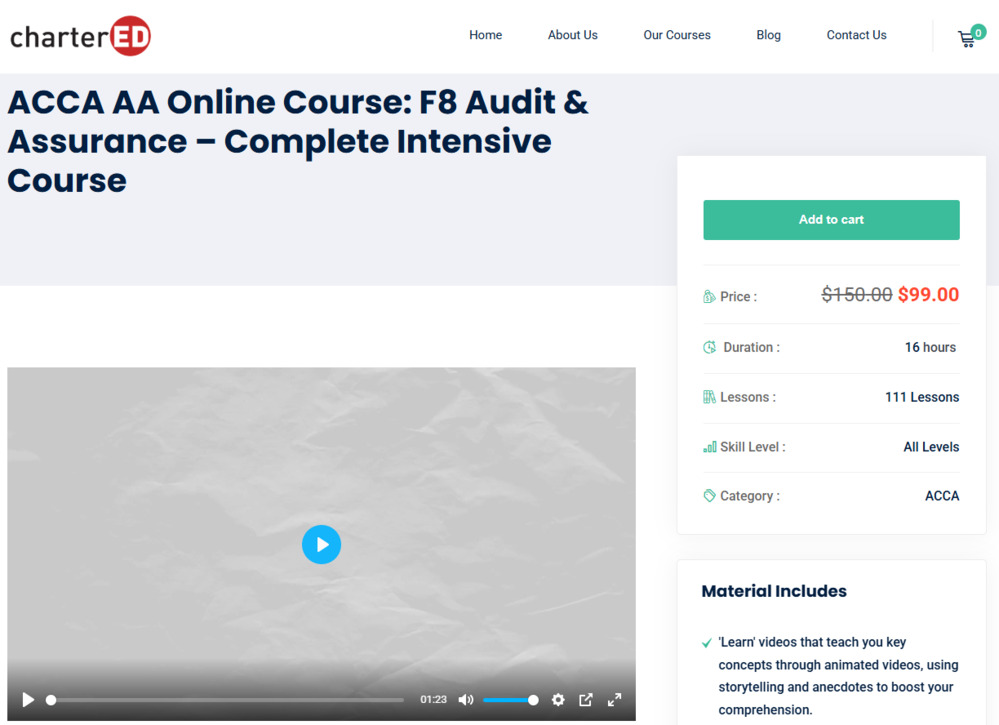
charterED’s ACCA AA Course: F8 Audit & Assurance is designed to close that gap. The course combines animated learning videos, structured study notes, and exam-focused walkthroughs to help students understand core audit topics without feeling overwhelmed by technical language.
Students are guided through key AA areas such as audit planning, risk assessment, audit evidence, internal controls, ethics, corporate governance, fraud and error, and audit reporting.
More importantly, the course shows how these concepts appear in exam-style questions, helping candidates move from passive revision to practical answer application.
Our visual approach with ACCA interactive learning material makes the learning process easier to follow. The course also includes multilingual support, including Chinese subtitles, making it suitable for learners who want clearer explanations in the language they are most comfortable with.
Taking our AA course to study ACCA while working full time gives you a structured route to revise smarter, practise better, and approach the exam with clearer technique.
Prepare for ACCA F8 with charterED
Passing ACCA F8 requires strong audit knowledge, practical exam technique, and the ability to apply concepts directly to the scenario in front of you.
The approach outlined in this guide gives you a clearer way to read requirements, spot audit issues, structure your answers, write specific procedures, and manage your time by marks.
Many candidates do not fail because they lack knowledge. They struggle because their revision lacks structure, exam focus, and guided practice.
charterED’s ACCA AA course is designed to help students build these skills through a more organised and supportive learning experience.
Contact charterED today to find out how our ACCA AA course can support your exam preparation.
Frequently Asked Questions About How to Pass ACCA F8 Exam
ACCA F8 is challenging because it tests audit application, scenario analysis, and exam technique, which charterED’s ACCA AA online course is designed to strengthen.
Most students need around 90 to 130 study hours, but charterED helps make that time more focused through structured lessons, revision support, and exam-style practice.
Key F8 areas include audit risk, internal controls, audit evidence, ethics, going concern, and audit reporting, all of which are covered in charterED’s ACCA AA course.
Yes, but students usually perform better with a clear study plan, and charterED can guide you on how to approach ACCA AA based on your current knowledge level.
Yes, charterED supports Chinese-speaking ACCA students through flexible online learning, experienced tutors, and clearer explanations for difficult AA exam topics.