Currently Empty: $0.00
CPA vs ACCA: Which Accounting Qualification Opens More Doors For You?

Choosing between CPA and ACCA is one of the most significant decisions you will make as an accounting student.
Both are globally recognised professional qualifications, but they serve different career paths, suit different academic backgrounds, and carry different weight depending on where you want to work.
This guide breaks down both qualifications so you can make a fully informed decision before you commit.
CPA vs ACCA: A Simple Comparison for Future Accountants
| CPA | ACCA | |
| Governing Body | AICPA (US state boards) | ACCA (UK-based, global) |
| Number of Exams | 4 sections | 13 papers (3 levels) |
| Typical Completion | 12–18 months | 3–5 years |
| Entry Requirement | Accounting degree (150 credit hrs) | Flexible; suitable post-SPM/A-Levels |
| Global Recognition | Strongest in the US | 150+ countries, strong in Asia & UK |
| Average Cost (Full) | USD 3,000–5,000 | USD 2,000–4,000 (varies by country) |
| Best Career Region | North America | Asia, Middle East, UK, Europe |
Certified Public Accountant (CPA) is mainly built for accountants who want to practise in the United States, with a strong focus on US GAAP, US tax, audit, and state-level licensing requirements.
Association of Chartered Certified Accountants (ACCA) is designed for a more international career path, with IFRS, management accounting, audit, tax, and strategic business topics recognised across markets such as the UK, Asia, the Middle East, and Europe.
In simple terms, CPA is the stronger fit if your goal is the US accounting market, while ACCA gives broader flexibility for students and professionals looking at international finance and accounting roles.
Contact charterED to learn more about our online learning support and find the right pathway for your next exam stage.
What Are the Entry Requirements for CPA and ACCA?

It is important to understand that both qualifications have different entry routes, education requirements, and eligibility rules depending on where you plan to study or practise.
CPA Entry Requirements
CPA has strict academic prerequisites. Most US states require a minimum of 150 credit hours of college education, which typically means completing a bachelor’s degree in accounting plus additional postgraduate coursework.
You must also have a Social Security Number and meet individual state board requirements, which vary across states.
For international students, this can be a significant barrier. If you did not study under the US system, meeting the credit hour requirement often involves bridging programmes or additional qualifications.
ACCA Entry Requirements
ACCA is considerably more flexible. Students can enter the qualification at different levels depending on their existing qualifications:
- Post-SPM or O-Level equivalent students can begin at the Applied Knowledge level
- A-Level or foundation diploma holders may receive exemptions for early papers
- University graduates with relevant degrees can earn exemptions for up to nine papers
This tiered entry structure makes ACCA more accessible for students from diverse academic backgrounds, including Malaysian students completing Form Five or pursuing pre-university programmes.
Exam Structure and Time to Complete for CPA and ACCA

Your choice between CPA and ACCA may also depend on how much time you can commit, how many exams you are prepared to take, and whether you prefer a shorter or more gradual study route.
CPA Exam Structure
The CPA exam has four sections: Financial Accounting and Reporting (FAR), Auditing and Attestation (AUD), Regulation (REG), and Business Analysis and Reporting or Information Systems (BAR or ISC).
You must pass all four sections within an 18-month rolling window. The exam is known for its intensity, with pass rates typically ranging between 45% and 60% per section.
ACCA Exam Structure
ACCA has 13 papers structured across three levels:
- Applied Knowledge (3 papers): foundational accounting concepts
- Applied Skills (6 papers): core technical skills in tax, audit, financial reporting, and management accounting
- Strategic Professional (4 papers): advanced and specialist subjects including Strategic Business Leadership
Students also need to complete an Ethics and Professional Skills module and fulfil a Practical Experience Requirement (PER) of three years in a relevant role.
ACCA exams are held four times a year, offering more scheduling flexibility than CPA.
Check out charterED’s ACCA study plan and how long it takes to complete ACCA.
Speak to charterED today and find out how our online courses can support your progress.
Where Does Each Qualification Take You in Your Career?

CPA and ACCA can both lead to strong accounting careers, but the roles, regions, and progression opportunities they support are not exactly the same.
CPA Career Path
CPA opens doors primarily within the United States. It is required for signing audit reports in most US states and is highly valued by American Big Four firms, investment banks, and corporate finance departments.
Salary expectations for US-based CPAs are strong, with median salaries consistently above USD 80,000 per year.
Outside the US, the CPA is still recognised but carries less weight unless you are working within a US-headquartered organisation or handling US tax matters for an international client base.
ACCA Career Path
ACCA’s career reach is considerably broader for students targeting roles outside North America. The qualification is recognised by all Big Four firms globally and is widely accepted by employers across Malaysia, Singapore, Hong Kong, the UAE, the UK, and beyond.
ACCA-qualified professionals work across audit, tax, financial management, consulting, and CFO-level roles.
For students in Malaysia and Southeast Asia, ACCA often provides a more direct route to professional roles at regional and multinational firms compared to CPA.
CPA vs ACCA Difficulty: Which Is Better for You to Manage?
CPA is usually harder for students unfamiliar with US accounting rules, while ACCA can feel more manageable because its exams build progressively across each level.
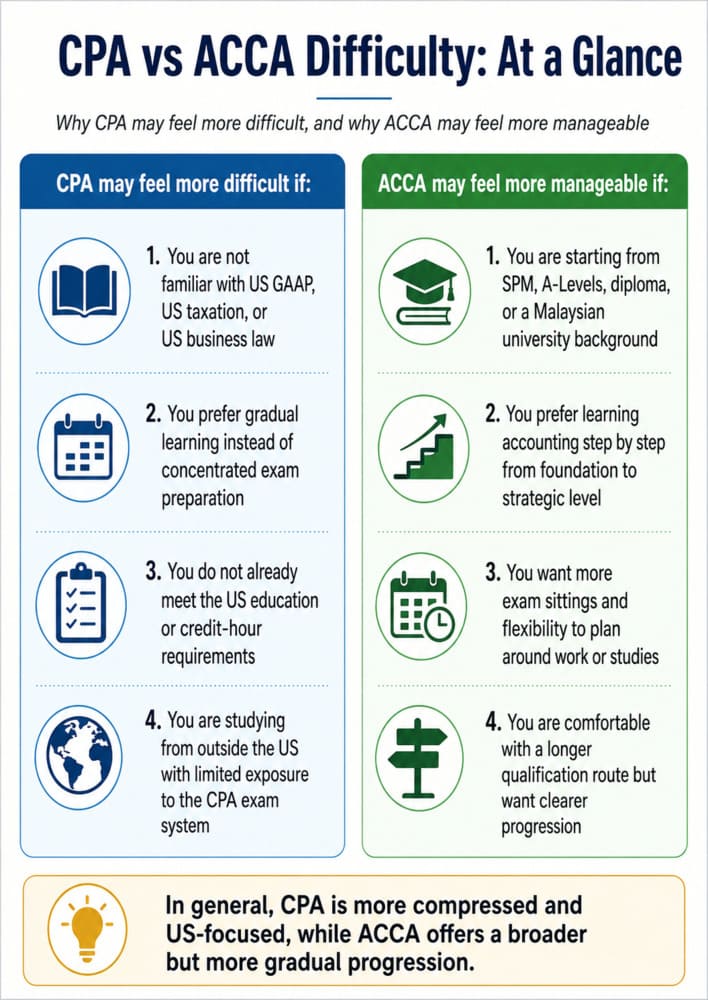
For most students in Malaysia and the broader Asian region, ACCA offers a more practical and globally transferable path. It is also easier to begin earlier in your academic journey, which means you can complete the qualification while gaining professional experience simultaneously.
Make Your ACCA Journey More Structured with charterED
Your qualification should match your career goal, study pace, and the level of support you need to stay consistent through each exam stage. ACCA gives many students a clearer route forward, especially when they need flexible learning that fits around school, university, work, or other commitments.
Strong preparation can make the ACCA journey feel more structured and less overwhelming. Guided lessons, exam-focused support, and a clear study pathway help students approach each paper with better direction instead of trying to manage everything alone.
charterED helps students prepare through flexible ACCA online courses that support different stages of the qualification, from early papers to Strategic Professional level.
Contact charterED today to learn more about the support available for ACCA online course students and find the right study pathway for your accounting career.
Frequently Asked Questions About CPA vs ACCA
CPA is usually more intense because it is compressed and US-focused, while ACCA has more papers but gives students a clearer step-by-step progression.
CPA is designed around US accounting practice, while ACCA is built for broader international finance, audit, reporting, and accounting careers.
ACCA is often the more practical route for Malaysian students because the entry pathway is more accessible and the qualification is widely recognised across Asia, the UK, and global markets.
Yes, students who prefer a more globally focused and progressive accounting route can consider ACCA as an alternative to the US-based CPA pathway.